


The causes of osteochondrosis of the chest spine are not sufficiently clarified.The greatest importance is attached to hereditary predisposition and age -related changes in intervertebral discs.
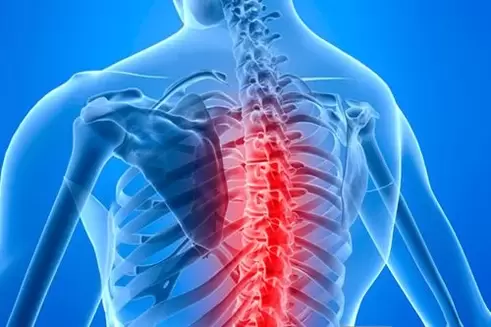
Osteochondrosis of the chest spine: Symptoms.
The first stage of the neurological complications of osteochondrosis of the thoracic spine.
Clinical manifestations are associated with reflex muscle tension.Dorxago (thoracic background).Acute pain in the chest region associated with movements.Exacerbation suddenly begins.The volume of movements in the thoracic spine is highly limited.The paravertebral muscles of the density of "stone".The proliferation of the dorsago with adequate treatment does not exceed 7 to 10 days.
Dorsalgia (back pain).The bodys complain of moderate pain in the thoracic region, intensifying during the movements or in a certain position, after a long session.The beginning is generally progressive.Clinically, curvature in the chest spine, tension and pain of paravertebral muscles are often determined.In most cases, the pain is to undergo for 2 to 3 weeks, but in the absence of treatment, a chronic course can follow.
PectallGy (chest pain).Breast pain is one of the most common complaints with which patients go to the doctor.The differential diagnosis in this case is carried out with cardiological diseases (pectoral angina, myocardial infarction).
Often, chest pain occurs in the bottom of osteochondrosis of the chest spine.The pain is deep, broken, painful, intensifies, with movements or with a prolonged stay in a position.In the thoracic region, the movement is limited, tense and painful on the paravertebral muscles of palpation.
With anterior chest wall syndrome, stupid, painful and prolonged pain on the front surface of the chest, intensify during hand movements, with body turns.Taking nitroglycerin under the language does not stop pain.Curular points are in the muscles of large and small thoracic.
The second stage of the neurological complications of osteochondrosis of the chest spine.
A hernia from the disc of the chest spine with a radicular syndrome is extremely rare.This is due to the structure of the structure of the chest spine.Compression of the spine (or intercostal neuralgia) is accompanied by a shot, burning pain of a surrounding character along the intercostality.The pain intensifies during movement, when breathing.
Often, breast size radio syndromes are accompanied by pain in various internal organs.In the event of damage to the upper thoracic roots, patients complain of pain and paresthesia in the throat and esophagus, on the feeling of a coma in the throat or behind the sternum.The presence of unpleasant sensations in the field of a pharynx or esophagus for a long time, many additional examinations and consultations lead to the development of neurotic reactions.
In patients with medium -sized roots, pain occurs in the stomach.Often, pain is accompanied by numbness on the anterior abdominal wall.With the pathology of roots with lower peak, pain can simulate intestinal pathology.Sometimes the pain in the abdomen is so intense that patients carry out unjustified surgery for pseudo-layers.
The defeat of the 7th, 8th or 9th spine on the right can imitate the pathology of the gallbladder or the liver.As an approach, stupid pains are located in the right hypochondrium.Boli and paresthesia when damage to breast roots are clearly linked to the movements of the thoracic spine, intensify with a long seat, while lying on the back, with cough or sneezing.
The third stage of the neurological disorders of osteochondrosis of the chest spine.
Vascular brown conflict.With small chest muscle syndrome, the plexus shoulders, the subclavian artery and the vein are tablet.The compression of these training courses can be caused by a strong abduction of the hand.Patients experience brushes and burning pain in the anterior chest wall during movements at night.In this case, paresthesia, numbness, weakness and pain in the hand occur.At palpation, the trigger points in the area of the small breast muscle are determined.An important differential diagnostic test is the elimination of pain after blocking the muscle.
The fourth stage of neurological complications of osteochondrosis of the thoracic spine.
Violation of the blood supply with the spinal cord.Chronic chest myelopathy is rare, which is associated with the anatomical characteristics of the spine.But with a narrow vertebral channel, the hernia of the disc can press the arteries and the spinal cord.The disease gradually begins, the weakness of the legs, a decrease in sensitivity in the lower half of the body, an altered function of the pelvic organs.
Constructive cerebrovascular disorder is the most serious complication of breast osteochondrosis.Suddenly, in the context of pain syndrome, leg paralysis, numbness, altered function of pelvic organs occur.
Examination of patients with osteochondrosis in the chest region.The analysis of complaints and history is of great importance to exclude a serious pathology.A neurological examination is carried out to exclude damage to the roots and the spinal cord.Manual examination allows you to determine the source of pain, limitation of mobility, muscle spasms.
Additional examination methods are presented in the event of a suspicion of specific back pain.If a somatic pathology is suspected, an in -depth clinical examination is carried out (ECG, an X -ray of lungs, FGD, an ultrasound of the abdominal cavity, etc.).
The radiography of the thoracic spine is prescribed to exclude tumors, vertebral lesions, infections and Shoyerman-Mau's disease.The signs of x osteochondosis have no clinical value, as all the elderly and elderly have it.
With radicular symptoms or spine, MRI or CT of the chest spine is indicated.On an MRI, the hernia and the spinal cord are better visible and the bone structures on CT.The clinical level of damage and the MRI of discoveries must correspond to each other.
Osteochondrosis of the chest spine: treatment.
In the acute period, in the presence of intense pain, the restriction of physical activity is indicated.With a decrease in the severity of pain, a progressive expansion of the engine speed is recommended.Sudden rotation movements in the chest spine should be avoided.
Intracanic electrical stimulation, acupuncture, hirudotherapy, massage, manual therapy are effective.Medical treatment.With acute pain, non-steroidal anti-inflammatory drugs are indicated.In combination with anti-inflammatory drugs, miradelaxing can be prescribed in the presence of muscle spasm.
With osteochondrosis of the thoracic spine, therapeutic blocking with local anesthetics (lidocaine, prokain), non-steroidal anti-inflammatory drugs (loroxs or melooxicams), corticosteroids (betamethason) are effective.The medicinal mixtures are introduced as close as possible to the pain.
With intercostal neuralgia, antidepressants, anticonvulsants, a Patch of Versathis is indicated.Porty (pentoxyphillin, aminophylline) drugs are prescribed, group B. Surgical treatment is carried out with spinal cord compression symptoms (paresis of the lower limbs, altered urine and excrement).
PreventionOsteochondrosis in the chest region is reduced to avoiding long uncomfortable positions when working at the table.It is important to properly equip your workplace, alternative work and rest periods, to regularly engage in physiotherapy exercises, to visit the swimming pool 1-2 times a week.